

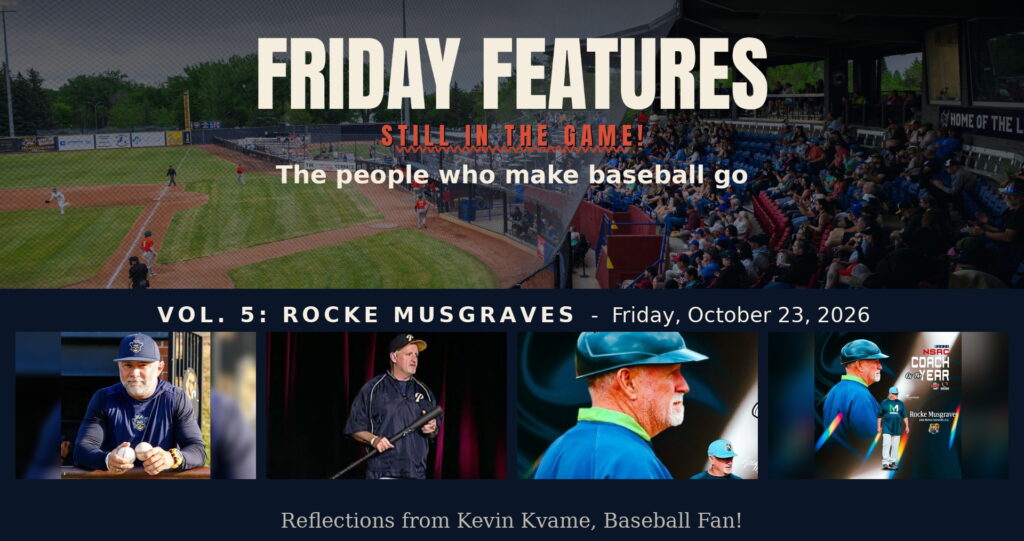
This week’s Friday Feature is a Still in the Game edition, and it’s about a man whose name isn’t on any wall at Spitz Stadium — but whose fingerprints are all over baseball in this city and around Southern Alberta. His name is Rocke Musgraves.
My baseball life started in Fort Macleod, where I helped start the Fort Macleod Royals American Legion team as a 19-year-old in 1985. After the 1987 season, our coach, Reed Spencer (former Lethbridge Elks skipper and teacher at Willow Creek Composite in Claresholm), moved on, and we needed a new man. Mike Barker, who was coaching the Lethbridge Elks around that time, gave me a name and a reference — a young coach from Arizona named Rocke Musgraves. I helped bring him in, and it turned out to be one of the best phone calls Southern Alberta baseball ever made.
This baseball lifer grew up around the game. I remember his stories of selling Dodger Dogs at Dodger Stadium and ice cream at the LA Coliseum for football games in Los Angeles. He had just graduated from university and was looking for a summer team to guide. Enter the Royals.
Rocke built winners in Fort Macleod. With people and baseball friends such as Al Park, Gordon Wolstenholme, and Ken Hann working with him, he coached the Royals and created competitive teams year in and year out. Among the accomplishments were back-to-back Northwest Regional Class A championships in 1993 and 1994.
I asked Rocke this week what he remembers about those years, and he didn’t hesitate. “I literally got goosebumps when you said those names,” he said. “I cut my coaching teeth on those years in Canada. I was able to tap into the Alberta attitude — the toughness and the rugged individualism of the farm kids. I could push those guys a little bit harder, and they accepted the push. I just wouldn’t let them off the hook, because they could take it.”
And he kept coming back to the families behind those players. “The parents are what I really remember,” he said. “They were full of discipline — the parents did such a great job of disciplining their kids, and expecting them to do right and to be tough. The strength of those teams was the type of kids and the type of families that were involved in those programs.”
And we want to pay close attention to who was playing for him in that time: a young Todd Hubka — yes, the same Todd Hubka who runs the Prairie Baseball Academy today — and Ryan Hall, who was drafted by the New York Yankees and now serves as the Technical Director for Little League District #1. That’s the kind of baseball tree that keeps growing. Rocke still talks to this day about another of his prodigies, Brad Molcak, who had incredible talent, and just missed taking that to the pros. I am going to cover some of the players on those Royals teams down the road so I won’t go into more depth now. I remember times visiting Rocke in his basement suite provided by Chris Chambers and him obsessing how to get Brad or other Royals to do the little things (and in some cases bigger things) correctly so they could be as successful as possible. Both Todd and Brad followed him south — Todd played for Rocke at North Idaho College, and Brad played for him at Pima College in Arizona. As Rocke puts it, their absolute strength was their mental toughness on a baseball field. “I always felt like it would take special kids to kind of break that barrier,” he says, “and they proved not only could they go down and play at the next level, but they could play very well.”
Rocke had plenty to say about Ryan Hall, too. “There were times when Ryan Hall was playing the game that I was scared of him,” he laughed. “Here’s the nicest kid in the world off the field, but golly, when he got on a field, that great competitive desire came out. He had something to prove, and he used the baseball field to prove it. What a joy to watch play.”
When he had put in his 7 years in the Fort, Rocke wasn’t done in Alberta. In 1995 he was coaxed away to coach Doug Jones’s Oyen Pronghorns — the lone Alberta team in the then Saskatchewan Major Baseball League — to the SMBL championship, the first Alberta team ever to win it. Hubka was there again, in the outfield and on the mound, alongside Cardston’s Brad Molcak and outfielders Tom Rodzinyak (former Bulls assistant coach) and Graham Schetzsle (Sylvan Lake Gulls owner) on a team that won its games by an average of six runs. That Pronghorns title opened the door for Doug to start the Lethbridge Bulls to join the league in 1999 — the league we now know as the WCBL. We celebrated the 30th anniversary of that 1995 Oyen championship team at the Rural Roots Classic last summer, and it still felt like a family reunion.
Rocke eventually went home to Louisiana and built a powerhouse at LSU Shreveport. In 14 seasons with the Pilots he won 584 games, took three teams to the NAIA World Series, and his 2012 club went 54 and 6 — one of the best records in NAIA history. And the Lethbridge pipeline followed him south: Former Lethbridge Bulls player and coach Brandon Magierowski went down to play for him, and Myles Fletcher — still sitting on the Bulls’ and PBA bench today — was an infielder on Rocke’s 2003 World Series team that finished third in the nation. Rocke is blunt about what that connection has meant. “Without the Lethbridge connection, there’s no way I would be where I am today,” he says. “Those players we got out of PBA pretty much set the table for a lot of championships at LSU Shreveport. I owe a great deal of my success to Alberta, Canada, without a doubt. I love to win — and you go get winners. I just love the attitude of those kids up there.”
From Shreveport he went to Northwest Nazarene in Idaho and took that program to its first-ever postseason. Then, in 2019, he did something that tells you everything about the man: he walked away from college coaching to run a recreation centre in Minden, Louisiana, so he could be home for his wife, Mitzi, and their kids instead of living on the road. Baseball could wait. Family couldn’t. He did however, pass on a love of the game to his two children. His daughter Libbi — Montana, named for his favourite fishing spot in the world, a place he travelled to during his Royals days — now works for the Single-A affiliate of the Tampa Bay Rays in Charleston, South Carolina, the RiverDogs. The team is partially owned by Bill Murray — yes, that Bill Murray, of Caddyshack, one of my favourite “sports” movies of all time. The family joke, according to Rocke, is that if they’d bet on which Musgraves would be the first to make it into professional baseball, nobody would have put their money on Libbi — but she’s the one who got there first. Son, Eli, has grown up with baseball in his blood and he is currently playing college baseball for his dad! I think that is a really special reason to be drawn back into the game. When I asked Rocke if coaching Eli is part of what pulled him back, the answer came fast: “Absolutely, 100%. I cherished the time away, being a husband and a father — but I did not enjoy real life. I didn’t enjoy a real job. When Eli became good enough to go on to the next level, that’s all I needed.”
Yes, the game has a way of calling people back. Rocke returned to build a brand-new program at John Melvin University in Louisiana, and in 2025 his Millers won both the conference regular-season and tournament titles, and he was named Conference Coach of the Year. This fall he took over at Columbia International University in South Carolina — the seventh college program he has led, after North Idaho, Pima, Nicholls State, LSU Shreveport, Northwest Nazarene and John Melvin — looking to add to his nearly 800 career wins across a near 40-year career, and still going.
And here’s the part that continues to make this a Lethbridge story again. This fall, a 2026 PBA (those Canadian College World Series champions) as well as a member of the 2026 Lethbridge Bulls, named Tetsu Nishida is playing for Rocke at Columbia International. Tetsu billeted at my place this past summer and was a quiet, polite, dedicated athlete who worked hard. It took me a little while, but I finally was able to connect the dots to this still in the game piece…..Tetsu played at PBA for Todd Hubka. Todd played for Rocke in Fort Macleod almost 40 years ago. I think that translates to Tetsu playing for coach’s coach and the COACH all in the same year. That’s pretty special and that’s what a baseball life actually looks like when it’s lived right. And Rocke reports that Tetsu has the edge as CIU’s starting shortstop, hitting in a prominent spot in the order — an exceptional student who works as hard in the weight room as he does on the field. “I’m selfish — I like to win, so I’m going to go get winners,” Rocke says. “And he’s definitely a winner.” He also loves what Tetsu is part of down there: a roster drawn from Mexico, the Dominican Republic, Canada, Australia and across the United States, where his two shortstops — a Japanese Canadian kid from Alberta and a kid from the American South, from completely different backgrounds — push each other and help each other get better every day, competing for the same job. “Baseball brings people from absolutely completely different backgrounds to form one team with one goal,” Rocke says. “That’s one of the funnest parts of my job.”
Thirty-eight years after a November 1987 phone call brought a baseball lifer north to Fort Macleod, Rocke Musgraves is still in the game — and the game around here is still better for it and I am a better person for having him as a lifelong friend. While writing this, the phone call to connect with him touched on a lot of other memories and people, far too many to put into this Friday Feature. So it creates many more chapters and fun stories to capture down the road. That 1st phone call was so important, but the ones ever since are much more cherished. And as Paul Harvey said in one of the best radio features I enjoyed back in the day, Now you know the rest of the story!
Published: October 23, 2026


